Penn alum creates a startup that helps regular folks predict flood zones
Business for Skillful: Dorothy
A Penn alum's startup helps regular folks predict flooding—something climate alter will make more necessary than ever
October. 29, 2019


In the aftermath of Hurricane Sandy, New York City faced an estimated $19 billion in damages. Subway lines were swamped or torn up. The city's historic Seaport district was flooded and Pier 17, 1 of its main attractions, was destroyed. The damages to lower Manhattan dominated headlines for months after the storm hit.

Adopt the audio version of this story? Heed to this commodity in CitizenCast below:
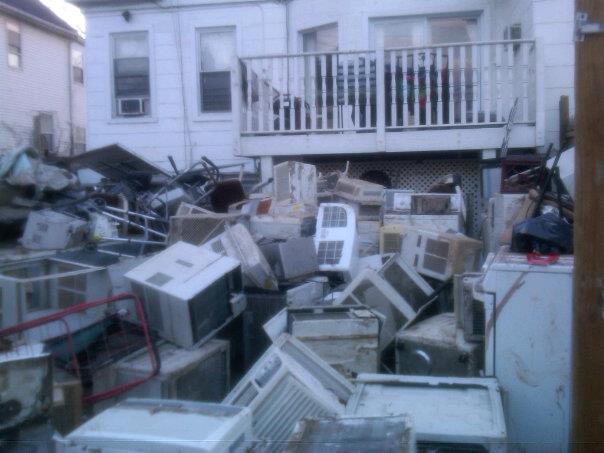
 While Manhattan made the news, Arianna Armelli, a New Yorker who grew up in the Bronx, was volunteering in The Rockaways cleaning upwards flood harm. The peninsula in Queens had little to no assistance after Sandy hit and the area looked "like a state of war zone," according to Armelli. Cars, clothes and droppings littered the streets. Dunes of sand were pushed nigh six blocks from the shoreline. Armelli and her friend had to have two trains and a bus to get to the neighborhood while conveying a shovel and a sledgehammer that they had brought with them.
As they went from house to house tearing down drywall from basements and showtime floors that had flooded, Armelli and her friend spoke to families and asked why this role of the urban center wasn't recovering every bit fast as Manhattan. They speedily noticed a pattern.
"The overarching response was their homeowner'south insurance didn't encompass floods and that they weren't aware that they weren't covered. Any sort of aid they were entitled to through FEMA would take months and they wouldn't be able to rebuild. Most families would not be able to keep their homes. These are average people who work hard and lost everything," Armelli says.
"A start-upwardly hears like some 60 no's during investment raises. Well, if nosotros go on showing up, someone is eventually going to say yes," Armelli says. "I am inspired when people tell me 'No, you can't, you won't.' I am inspired by maxim I did."
Armelli didn't merely take in the damage from the storm and the stories people told her. She decided to do something about information technology. Last twelvemonth, she created Dorothy, a outset-upwardly that uses machine learning, artificial intelligence and satellite imagery to create maps of flood zones which can aid people know if a house is in a flood zone before they purchase it. Named for the protagonist of the Magician of Oz whose life was disrupted by a natural disaster, Dorothy was able to model inundation damage from 2017'due south Hurricane Harvey lx percent more accurately than Federal Emergency Management Bureau maps in three primal locations.
Since its inception in July of 2018, Dorothy has received support from the University of Pennsylvania'southward Pennovation Accelerator program, which allowed them to get their beginning by providing free co-working space in 1776 and access to resources through the Pennovation program. Armelli has since pitched her product at South by Southwest in Austin.
While the seeds for what would somewhen go Dorothy were planted as she worked every bit a volunteer fighting flood impairment in New York, Dorothy is very much a Philadelphia-built-in commencement-up. Equally a young architect and planner who watched her city get rocked by a superstorm, Armelli knew she was interested in flooding. This interest led her to the Academy of Pennsylvania's Weitzman School of Design, which has one of the best masters degree programs for landscape design in the country, with a focus on regional planning and resilience––two of the keys she would need to start Dorothy.
But it wasn't until Hurricane Harvey hitting Houston and Hurricane Maria hit Puerto Rico that Armelli decided to dedicate her career to ameliorate flood mapping in particular.
 "At that place were a few topics that jumped out at me during the news coverage. First, the government response to these storms was drastically different. Second, reports stated that 75 percent of the impairment occurred outside of FEMA inundation zones and 80 percent of the homeowners afflicted were uninsured. I decided and so and there that this would be what I would dedicate my career to," she says.
Armelli says role of the reason so much of the damage was outside of FEMA overflowing zones is that the system is responsible for both mapping floods and providing disaster relief. Under President Trump, already-deficient funds have gotten increasingly tight. In August, $155 one thousand thousand from FEMA's disaster relief funds was diverted past the Department of Homeland Security to support Immigration and Customs Enforcement's purchase of detention beds and court instance costs at the border, as reported past NPR.
As climate modify continues to cause increasingly volatile storms, FEMA'southward money oft has to exist directed towards disaster recovery, rather than prediction. Under the Trump administration, FEMA has also dropped whatever references to "climate change" from its strategic program, making it even harder for disaster preparedness that's needed. Currently, Armelli says, FEMA is Dorothy's main competitor, since it is the standard for inundation mapping in the country.
"At the continuous rate of these severe hurricanes, [their] budget is essentially dedicated to reactive efforts rather than proactive," Armelli said.
FEMA is responsible for both mapping floods and providing disaster relief. Under President Trump, already scarce funds have gotten increasingly tight. In Baronial, $155 meg from FEMA's disaster relief funds was diverted by the Department of Homeland Security to support Immigration and Customs Enforcement.
A proactive approach to disaster is at the core of Armelli'southward business. Dorothy puts planning for floods into the hands of homeowners by creating meliorate maps of overflowing zones. This allows them to gauge how likely it is for their house to be flooded if a hurricane or superstorm hits their community. Once homeowners run into where their house falls within a floodplain, they can besides use Dorothy to find and purchase insurance quotes. Currently, the company's website has a feature that consumers tin can utilize to get more information and request an insurance quote. They plan to sell their production to large- and small-scale-scale property owners, home buyers and insurance companies.
Armelli's experience equally a volunteer cleaning upwardly after Superstorm Sandy allowed her to see outset mitt how some areas receive federal help while others struggle to recover and she brings that mindset to her piece of work with Dorothy. "I remember vividly, going dorsum to work [in Manhattan] one week after the hurricane hit. The city seemed unfazed," she says. "We spent the entire time vehement downward walls and insulation and just generally covered in garbage. We spoke to the families nosotros helped and asked why the surface area wasn't recovering as apace as Manhattan."
"We would similar to better prepare property owners before any of these storm events happen. Nosotros're focused on developing more accurate flood hazard information and offering proactive options that benefit the end users," Armelli says. "We are accurate, easily digestible, and protect your well-nigh valuable nugget, your livelihood and home."
Ken Steif, director of Penn'south Main of Urban Spatial Analytics and a lecturer in the university's city planning section, has taught a course since 2022 in which students utilise bachelor data to predict flooding. He sees promise in products like Dorothy, that fill in the gaps where government falls short in planning for floods and other natural disasters.
"The promise is in the power to generalize from places that have experienced a inundation event to comparable places that have non," Steif says."There are a host of utilise cases across the public policy realm where this technology has helped us place risks that authorities can and so work to mitigate."
He cautions, however, that new technologies should influence how policy is created and not dictate it. Artificial intelligence is not a one-stop solution for problems like flooding where income levels, housing bigotry and other factors also dictate where people live and how much assist they receive when disaster hits.
A study from the journal Science Advances found that wealthy areas are more likely to receive regime buyouts for homes within overflowing zones, leaving poorer families at risk and disproportionately benefiting the wealthy.
While a slew of factors go into making public policy, data and the predictive technology should be a part of the conversation. Steif cautions against both seeing engineering science equally a one-terminate solution and mistrusting it entirely.
"Most families would not be able to continue their homes," Armelli says. "These are average people who work hard and lost everything."
"The greatest impediment are those that call back nosotros only plug in a magic "AI" box to solve our most complex bug," he notes. "Conversely, others call back that by default, algorithms exhibit outright bias and discrimination. The truth is that these tools can be very powerful when developed and validated in the context of the public-policy use case in which they are being deployed."
As Dorothy continues to grow, Armelli hopes that it will be able to help the average, hard-working people, like those she met in the Rockaways, experience a piddling more secure in their homes.
Currently, the business has v employees who, like Armelli, are working for free; near are living off of their savings, including Armelli, who has money from when she worked as an architect. They have been pitching Dorothy and entering the business into startup accelerators and other competitions. Recently, they were named a semi-finalist in the Ashoka Changemakers and QBE North America Urban Resilience challenge.
 Armelli also recently attended a boot camp in Boston for AcceliCITY, a smart urban center accelerator where they were able to pitch their production to investors. If they win the AcceliCITY they have the chance to win betwixt $25,000 and $75,000. As an AcceliCITY finalist, Dorothy has earned nigh $100,000 worth of global marketing through the accelerator'south partner, "bee smart metropolis."
For now, Armelli plans to go along working and keep pitching her business as she grows Dorothy into "the national standard for climate risk information."
"A start-up hears similar some threescore no'due south during investment raises. Well, if we keep showing upward, someone is eventually going to say yes," she says. "I am inspired by hard problems. I am inspired by helping those who tend to be forgotten about. I am inspired by following my passion and building something that is a reflection of that. I am inspired when people tell me 'No, yous tin can't, you won't.' I am inspired past saying I did."
Related Stories:
- The DNC is failing black voters by nixing the climate debate
- The economical case for fixing Philly's murder problem
- Apartment projection in Kensington offers residents discounts if they volunteer

Source: https://thephiladelphiacitizen.org/arianna-armelli-dorothy/
0 Response to "Penn alum creates a startup that helps regular folks predict flood zones"
إرسال تعليق